

[ad_1]
Most SEO reports go unread.
Or, worse — they get skimmed, misunderstood, and ignored.
But knowing how to create an SEO report that demands attention can change everything.
It’s not just a performance recap.
It’s a strategic tool that helps you build trust with decision-makers. Win bigger budgets. And keep your SEO efforts on track.
In this article, you’ll learn how to:
- Create SEO reports that people actually read (and act on)
- Tie SEO performance to business goals
- Highlight wins and uncover growth opportunities
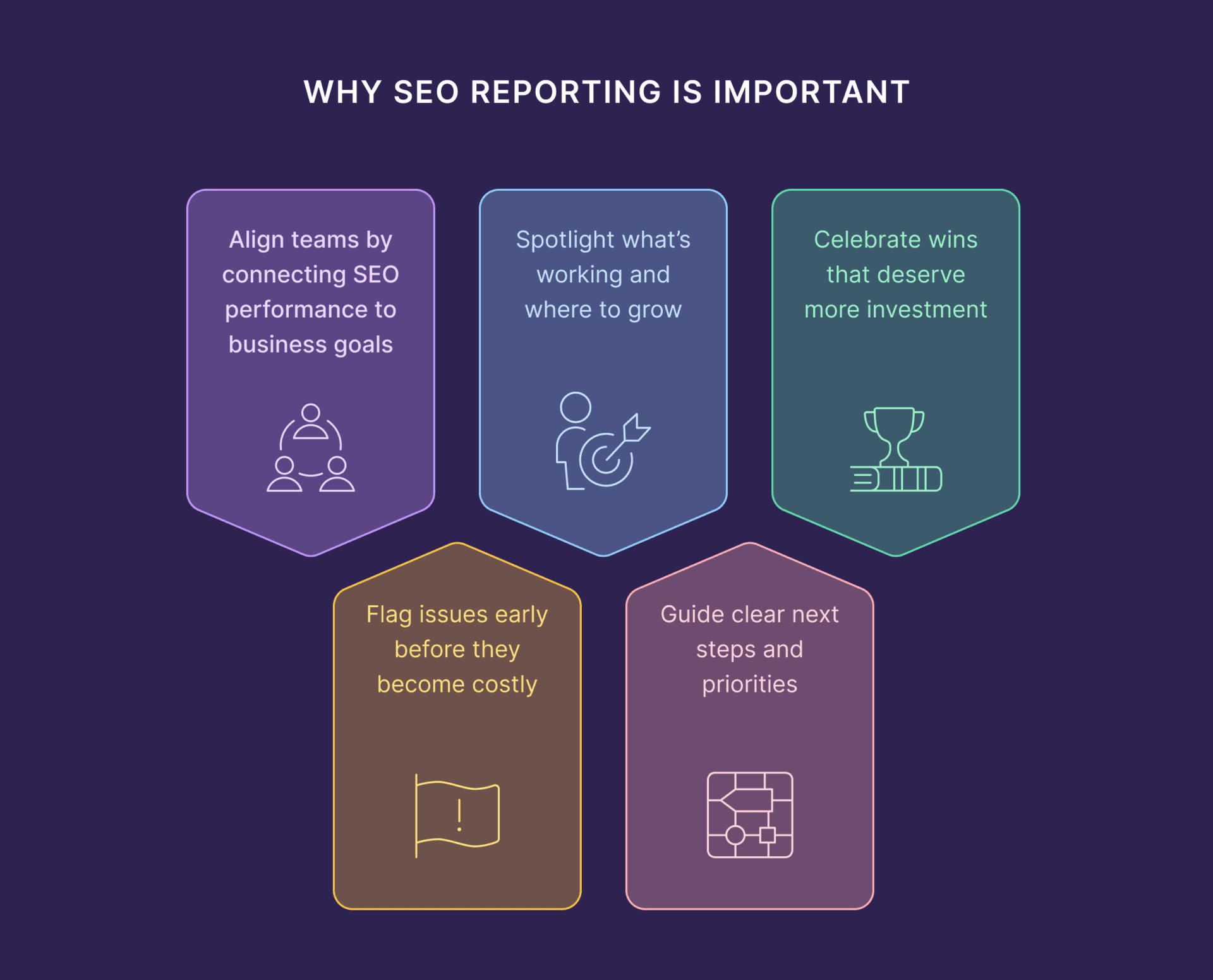
What Is an SEO Report and Why Is It Important?
An SEO report is a tool for measuring performance and shaping strategy.
It tracks key metrics like traffic, rankings, and conversions.
Then, connects them to business outcomes, opportunities, and priorities.
A strong SEO report helps answer:
- What changed?
- Why did it happen?
- What should we do next?
For example, let’s say you run SEO for a workplace furniture ecommerce company.
You notice a spike in traffic and rankings for your category page on ergonomic office chairs.
Here’s how a useful SEO report would break that down:
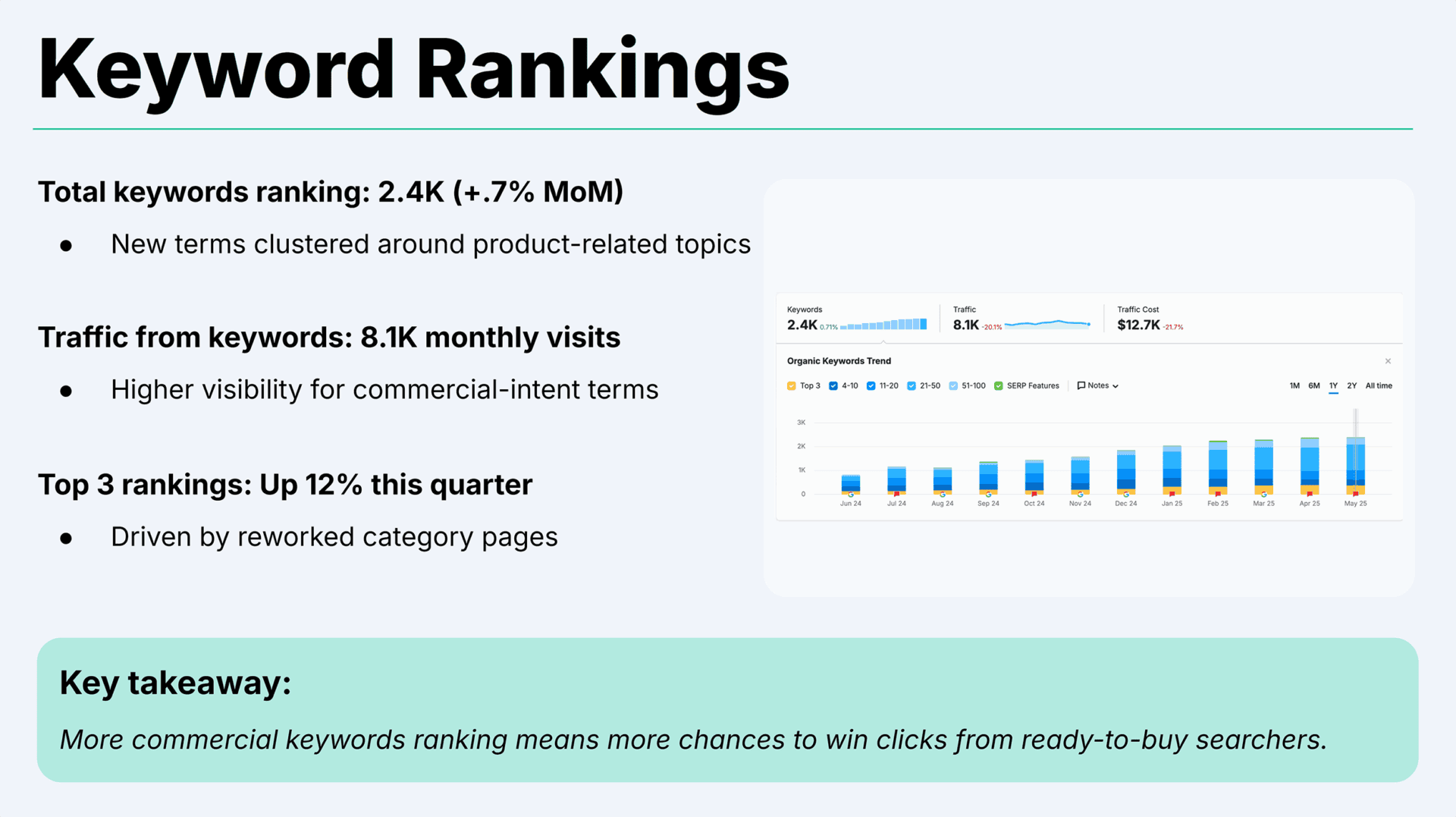
It’s a clear, focused snapshot that distills the data into what improved, why it happened, and why it matters.
How to Create an SEO Report That Drives Results
Too many SEO reports dump data without insight.
Traffic, rankings, and top pages might look impressive — but they don’t tell the full story.
And without context, stakeholders are left guessing.
The best SEO reports connect the dots. They tie performance to business goals, spotlight what’s working, and make the next move obvious.
Here’s how to build one that actually drives results:
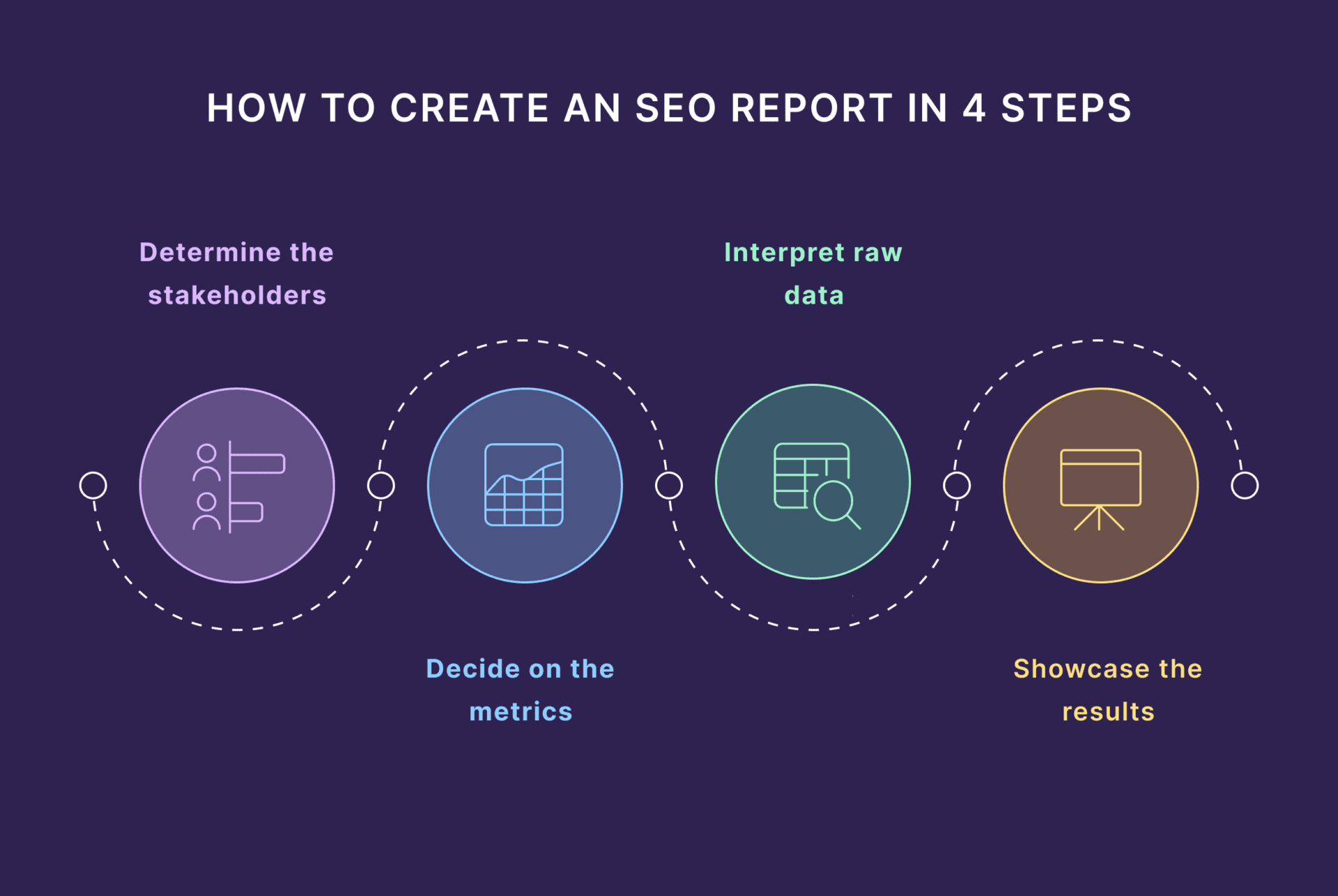
Step 1: Determine the Stakeholders
Before pulling data or building charts, get clear on who you’re reporting to.
Knowing your audience should shape your whole report, from the SEO stats you’re using to how you communicate them.
Ask yourself:
- Who will read this?
- What do they know about SEO?
- Who will be making the decisions?
- What decision do I want them to make?
And here’s one more that’s just as important:
Have I asked what metrics actually matter to them?
A quick conversation can surface priorities that no dashboard will show you.
From there, tailor the format, metrics, and language accordingly.
(This is where many SEO reports go sideways — too much data, not enough direction.)
Here’s a quick breakdown of how to match your audience to your data and format:
| Stakeholder | What They Care About | What to Show | Format Tips |
|---|---|---|---|
| CMO / Exec | Revenue, ROI, brand authority | Conversions, organic-assisted revenue | Keep it short, visual, and business-focused |
| Marketing Team / Managers | Channel performance, goal tracking | Traffic trends, keyword growth, top pages | Include takeaways and next steps |
| Product Team | Feature discovery, UX gaps | Search query trends, on-page feedback | Highlight qualitative insights and opportunities |
| Small Business Client | Clear wins, reviews, local visibility | Local rankings, top queries | Use plain language and short summaries |
For example, if your primary audience is a CEO or CMO, you probably wouldn’t lead with details about unindexed pages or on-page engagement time.
Likewise, a report for a small business owner with zero SEO background shouldn’t be packed with complex metrics or jargon.
They need simple wins, clear summaries, and next steps they can act on.
How to Report to Non-SEO Audiences
Working with clients who don’t speak SEO?
You can help them level up their knowledge by translating industry terms into easy-to-understand language.
Add simple explanations to your reports and introduce new concepts one at a time.
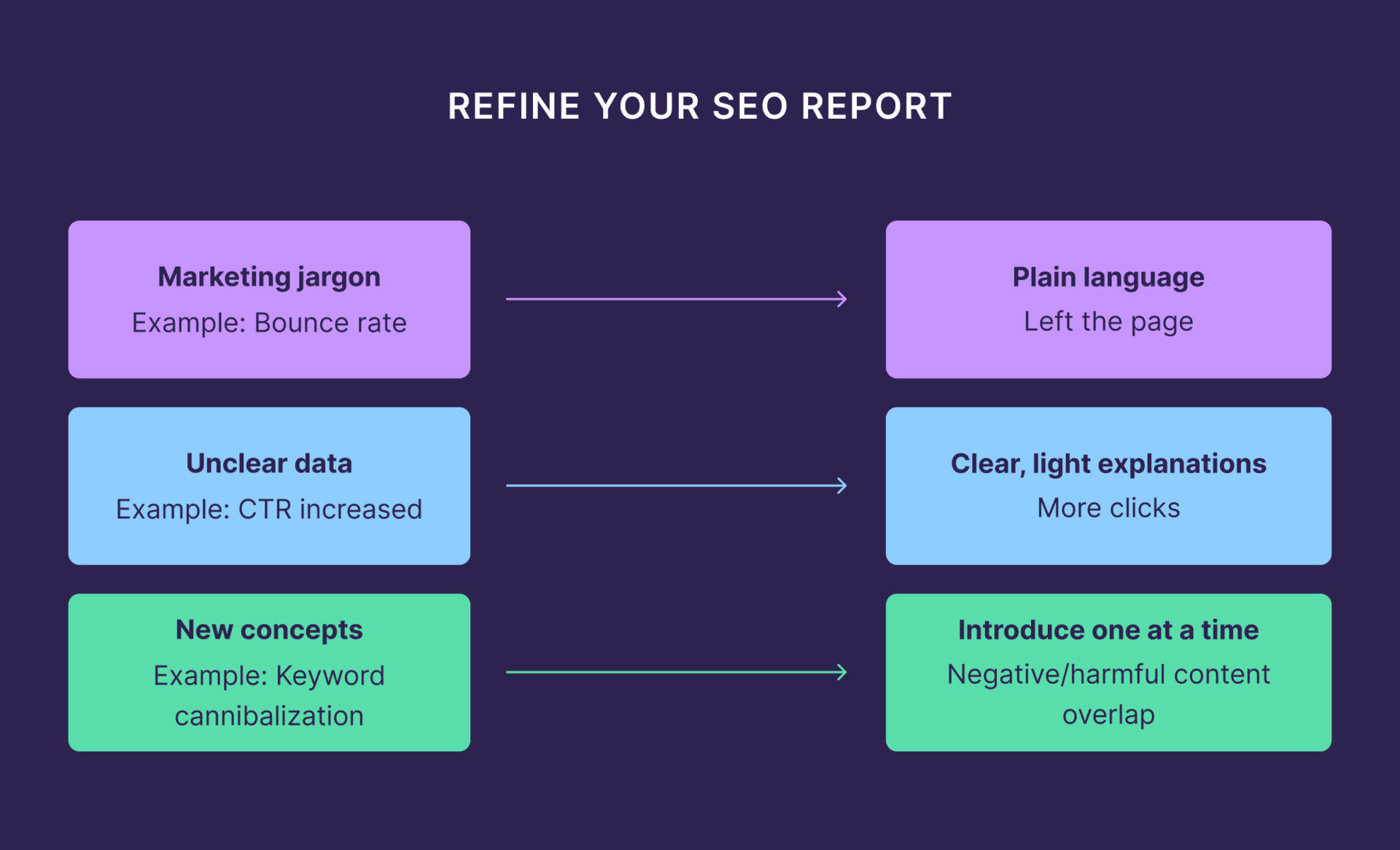
Here are three ways you can do this in your SEO reports:
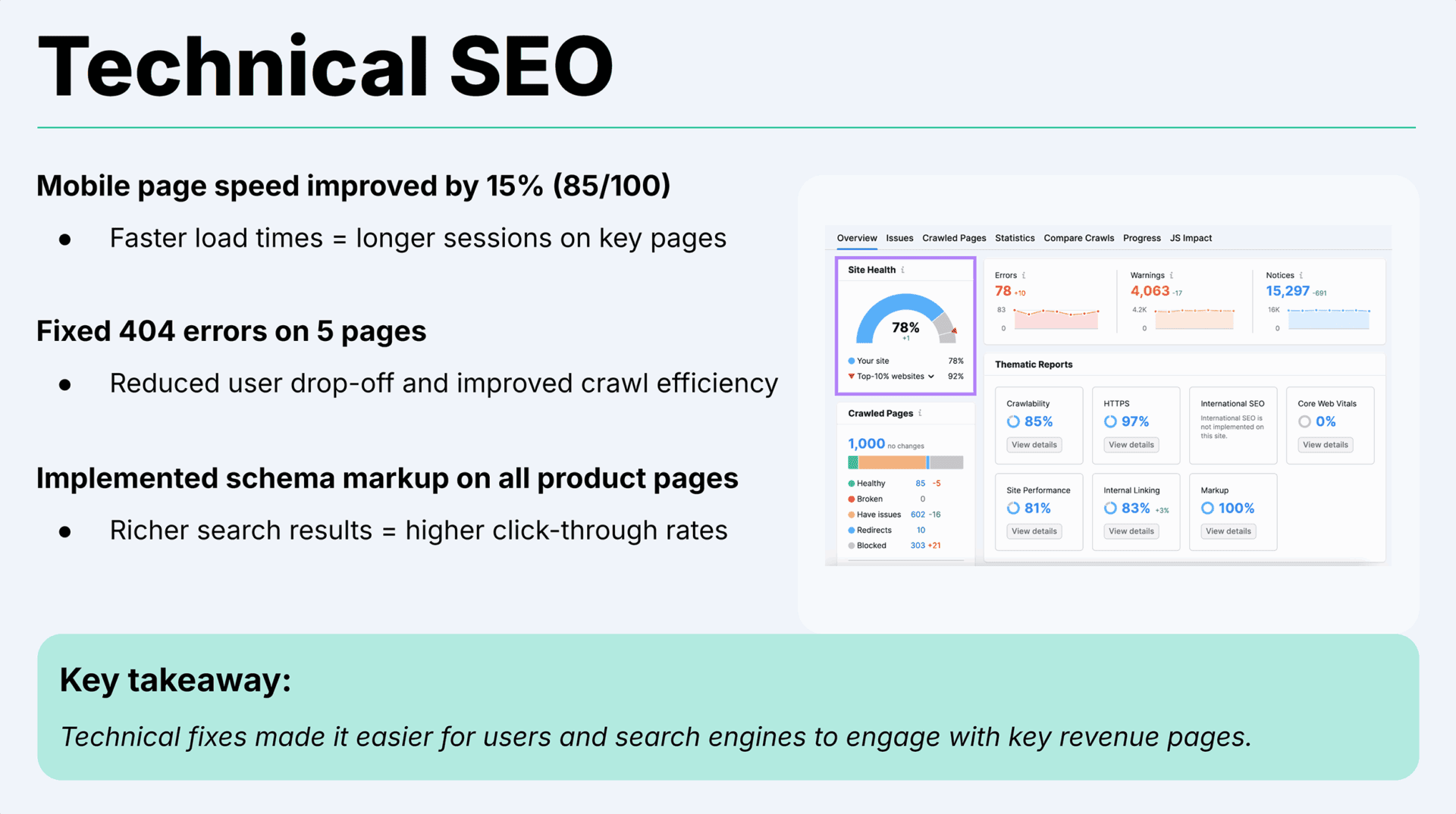
1. Include key takeaways to clarify complex points.
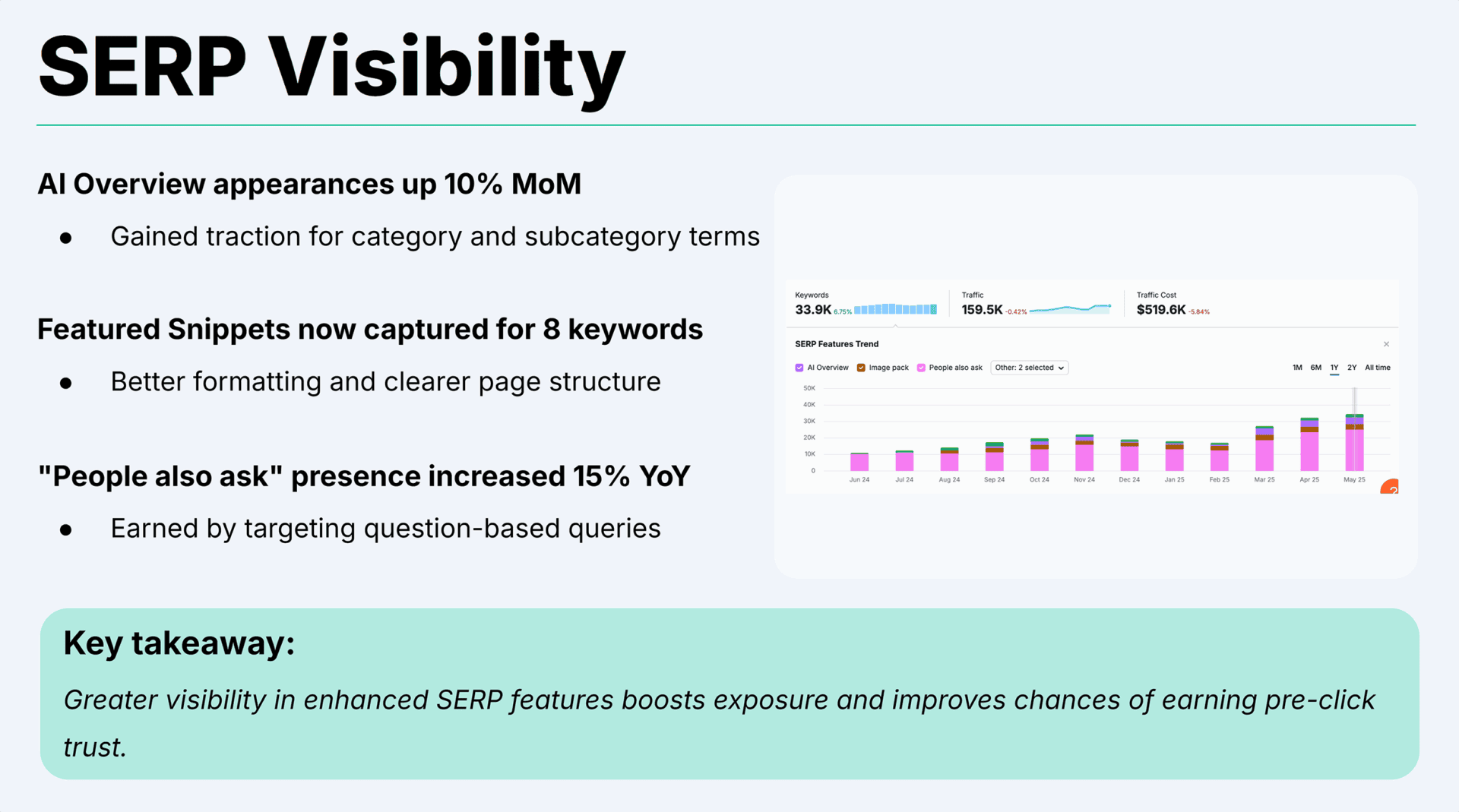
2. Add links to educational resources on SEO concepts.
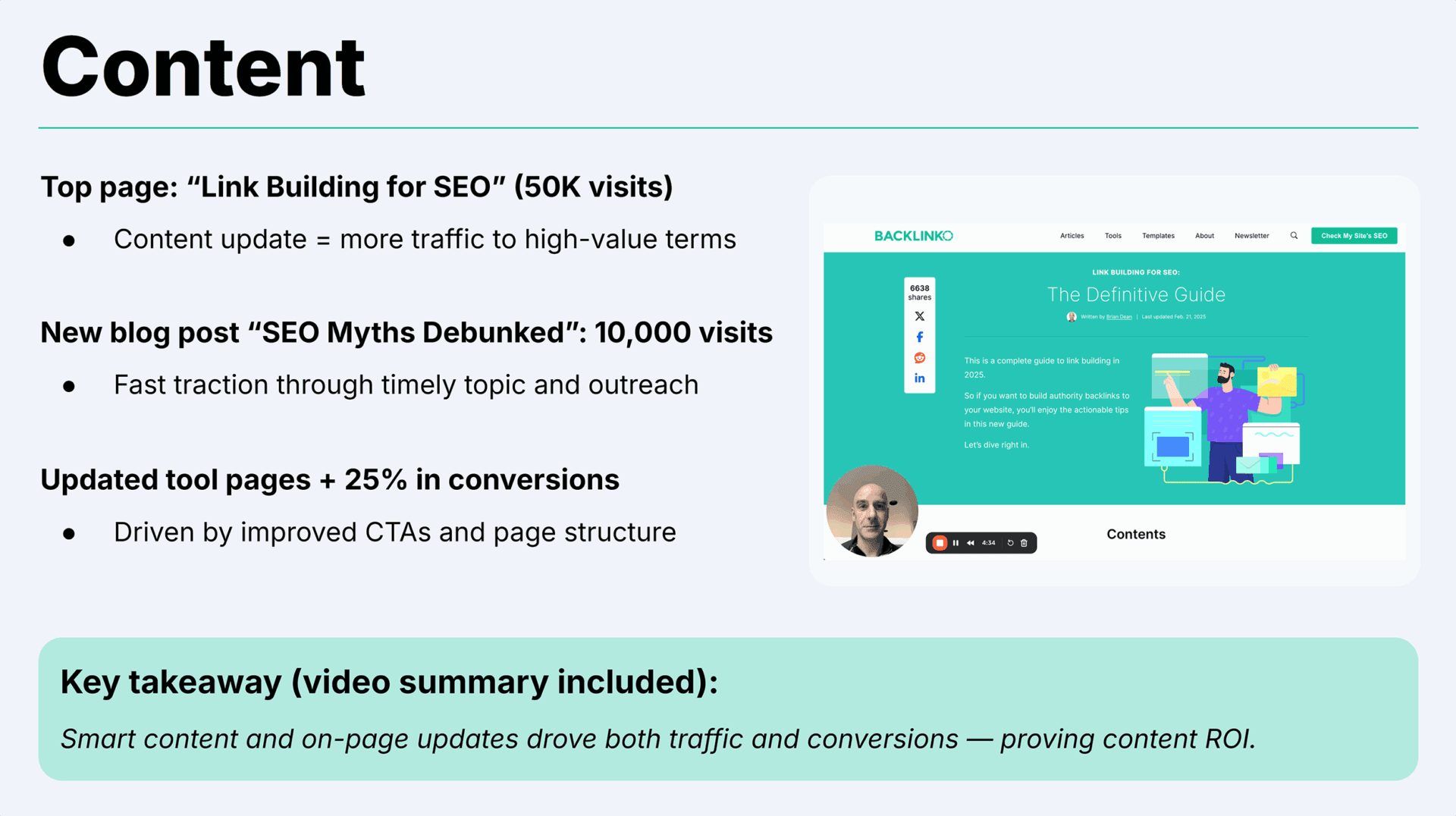
3. Add short videos with explanations of the client’s data or performance.
Step 2: Decide Which Metrics Matter Most
Start with the key SEO metrics every report needs, no matter the audience.
| Metric | Why It Matters |
|---|---|
| Conversions | Connects SEO to real business results. Key for proving SEO ROI. |
| Organic traffic + engagement (including click-through rates and average position) | Shows how well your pages attract and keep search visitors — great for spotting what’s working. |
| Organic impressions | Highlights search visibility and signals growth or dips in core topics |
| Keyword trends (rankings, top non-branded keywords) | Shows what’s gaining traction and where to focus next. Helps spot cannibalization or decay. |
| Backlink profile health | Keeps tabs on link trust and growth. Important for authority. |
| Technical health | Identifies site issues that hurt SEO. Vital for maintaining crawlability and indexability. |
| SERP features | Tracks special placements that boost visibility (e.g., featured snippets, video results, or shopping carousels) |
| LLM visibility | Shows brand mentions and citations in AI tools like ChatGPT, Gemini, and Perplexity — key for influence in AI-driven discovery. |
You can find the majority of your must-have metrics in SEO tools like Google Search Console (GSC) or Semrush.
Add-On SEO Report Metrics
Once you’ve covered the essentials, you can layer in additional metrics depending on your team’s strategy and goals.
| If you’re prioritizing: | Include metrics like: |
|---|---|
| User engagement | Scroll depth, bounce rates, dwell time, and GA4 engagement metrics |
| Topical authority | How well your content ranks for key themes |
| E-E-A-T signals | Mentions, expert authorship, branded searches, trust indicators (e.g., social shares) |
| Content library ranking efficiency | What % of your pages rank in the top 10 to guide pruning or reinvestment. |
Step 3: Turn Raw Data Into Actionable Insights
Raw data doesn’t drive decisions — clear stories do.
Knowing how to create an SEO report means turning numbers into narratives.
It needs to clearly tell a story around these questions.
- Is our SEO strategy working?
- What changed?
- Why did it change?
- What should we do next?
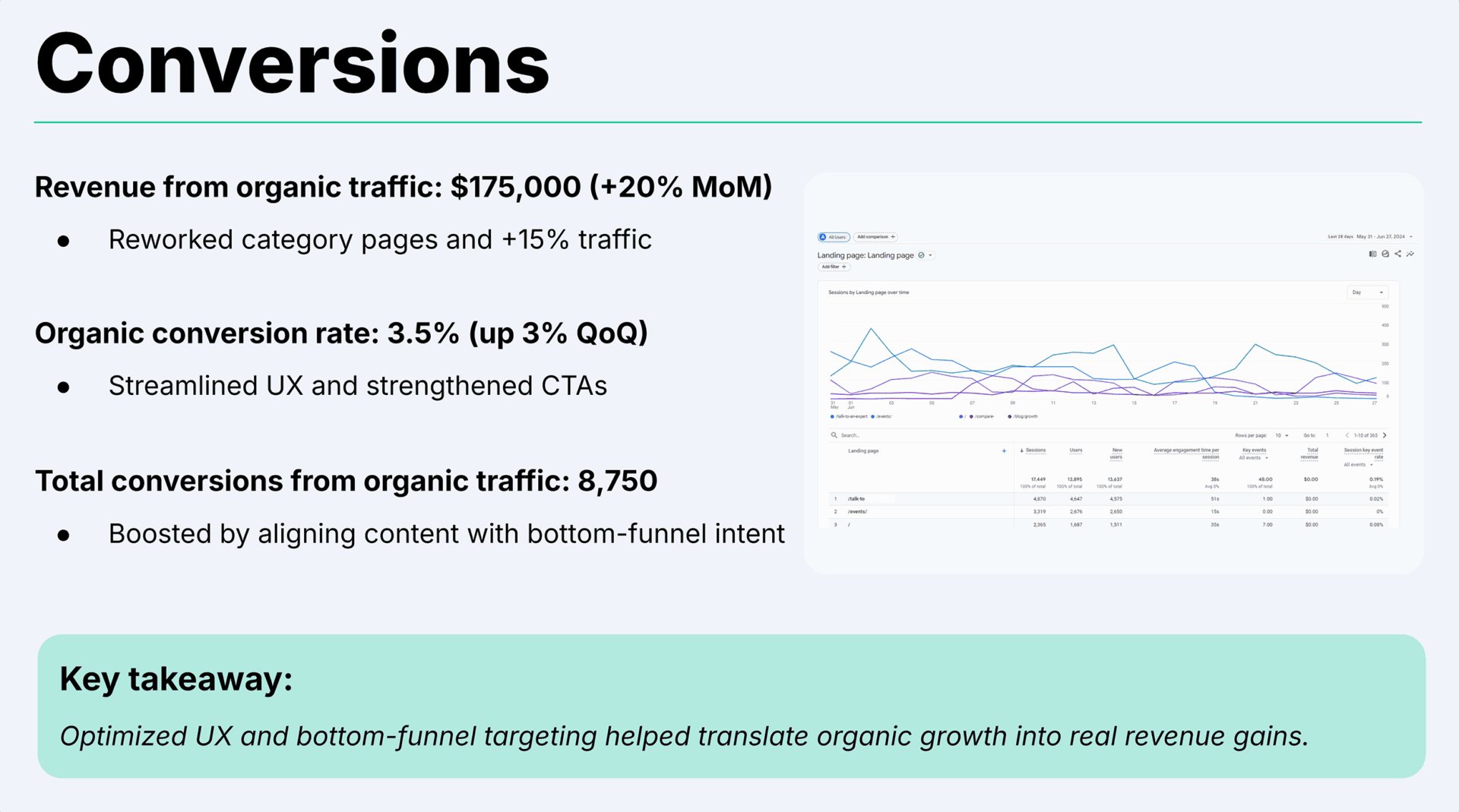
One of the best ways to tell the story is through time-based comparisons.
Show how SEO performance has changed month-over-month (MoM), quarter-over-quarter (QoQ), or year-over-year (YoY).
Highlighting changes over time makes it easier for stakeholders to spot trends. And understand why they matter.
For most SEO teams, the challenge isn’t collecting data. It’s translating it into context stakeholders care about.
Raw numbers might make sense if you’re inside the tools every day.
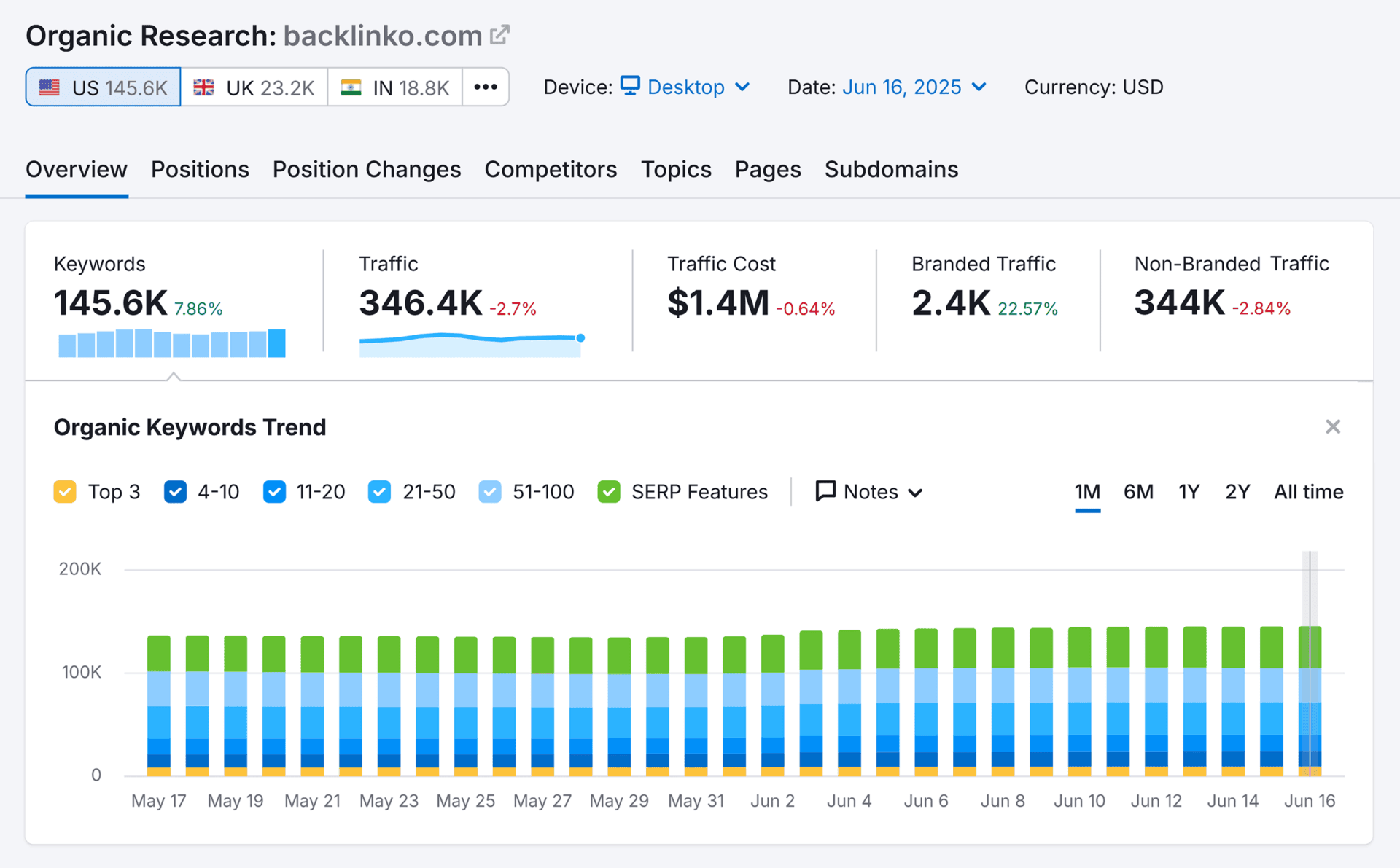
But executives and cross-functional teams need more than charts. They need meaning.
The best reports go beyond what changed. They explain why —and connect the dots to business impact.
Like this:
| Metric | Increase Might Mean | Decrease Might Mean |
|---|---|---|
| Organic traffic + engagement (CTR, avg. position) | Higher rankings or better-optimized content | Rankings drop or poor user experience (UX) |
| Organic impressions | More visibility in search | Lost rankings or SERP features |
| Keyword trends | New or improved keyword rankings | Declining rankings or outdated content |
| SERP features tracking | Gaining authority in SERPs | Dropped from features or lost relevance |
| Conversions | SEO traffic is converting better | Traffic mismatches or UX issues |
| Backlink profile health | More quality links or mentions | Lost links or declining authority |
Translate percentages and numbers to what actually happened:
- What new pages were published?
- Did your development team ship technical fixes?
- How many backlinks were earned?
- Are algorithm changes or seasonal searches a factor?
Most importantly, link the SEO impact to business terms.
For example, let’s say your top product page jumped from position No. 9 to No. 3.
In the same month, inbound demo requests doubled.
That’s not just a ranking improvement. It’s a signal that higher visibility on the right terms is driving qualified traffic.
In this case, the takeaway isn’t just “rankings are up” — it’s that SEO is contributing directly to revenue growth.
Step 4: Showcase the Results
A great SEO report doesn’t overwhelm your reader — it guides them.
It frames wins. Flags issues. And makes the next move crystal clear.
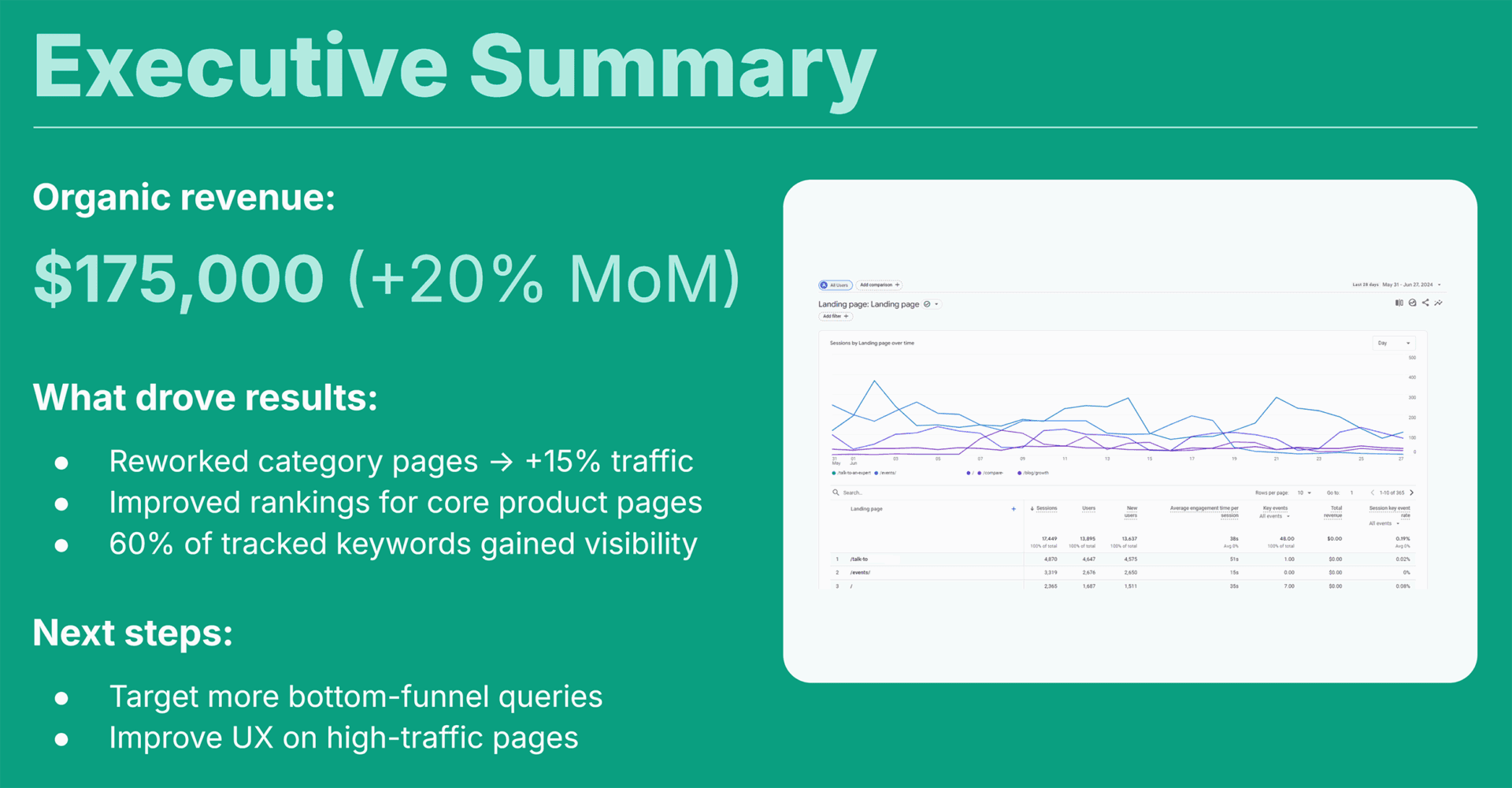
Executive Summary
Start with a snapshot that shows where things stand.
The Executive Summary gives a high-level view of key metrics and overall performance trends.
So, stakeholders can get the big picture fast.
Keep it sharp and clear. Spotlight what’s working, what’s driving it, and where to go from here.
Performance Metrics
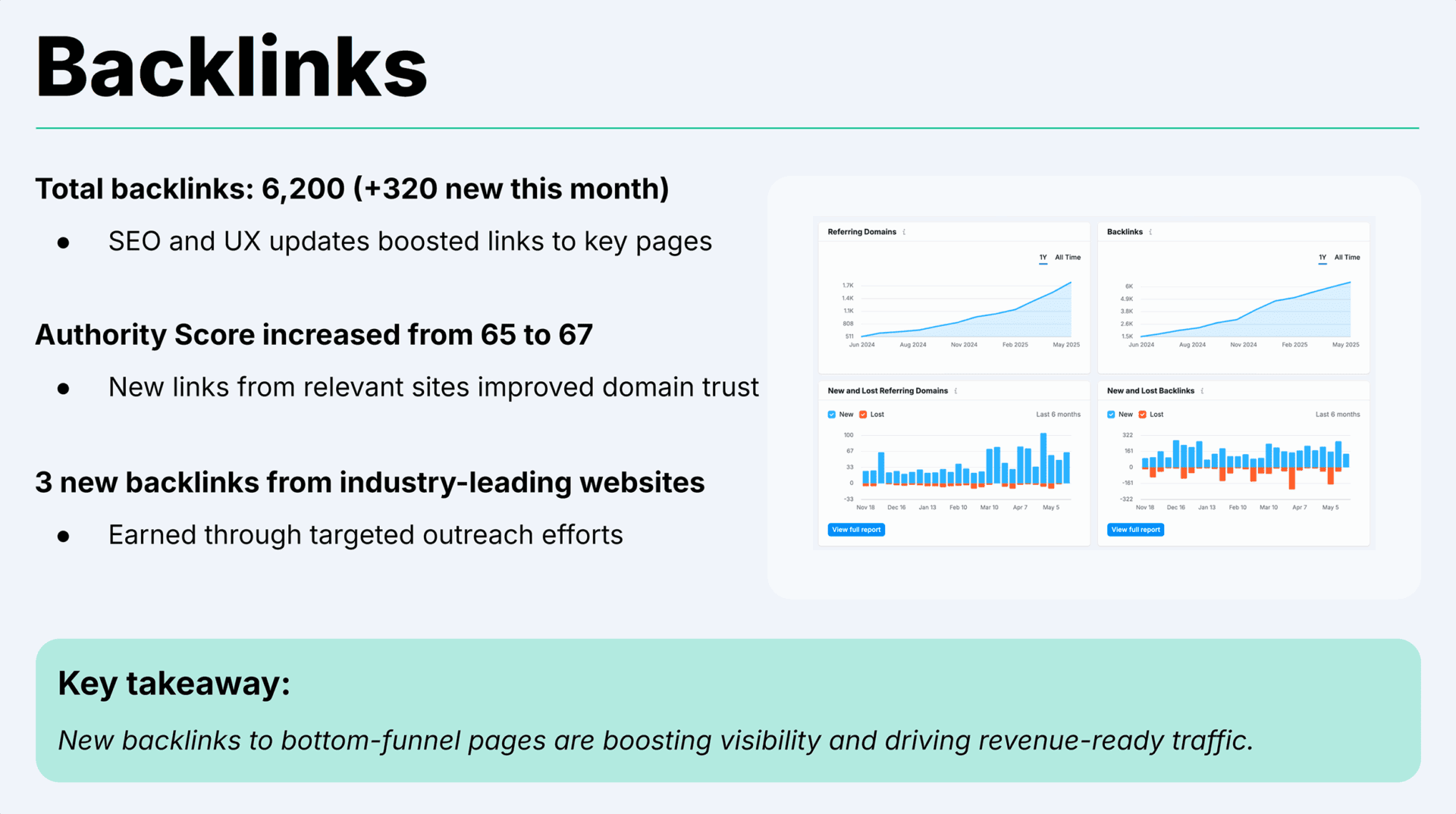
This section covers your core SEO performance data — like traffic, rankings, keywords, and backlinks.
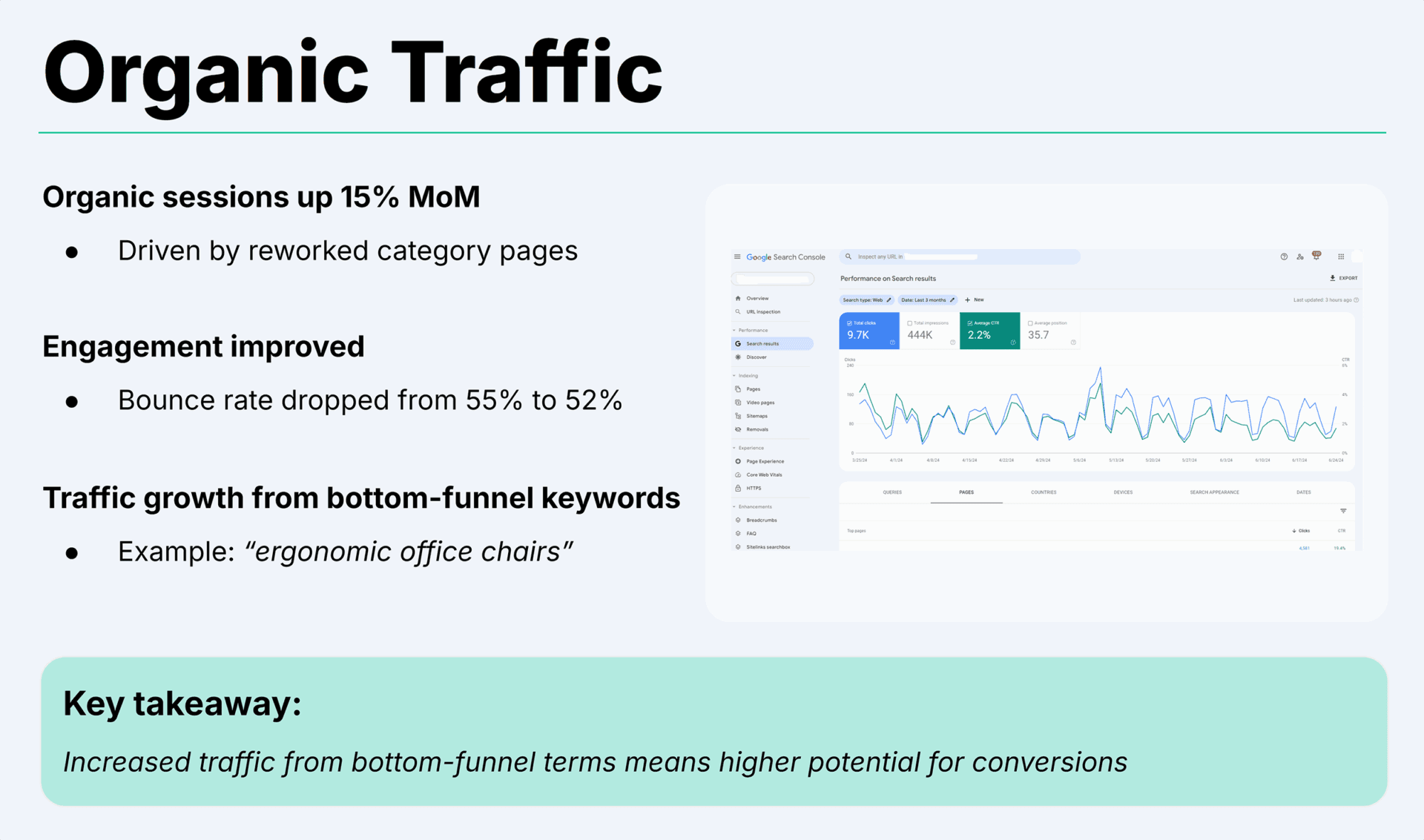
Include context and key takeaways.
When showcasing trends, show the progress over time, not just one-off wins.
And use visuals as much as possible.
Charts, graphs, and annotated screenshots really can make your performance insights pop.
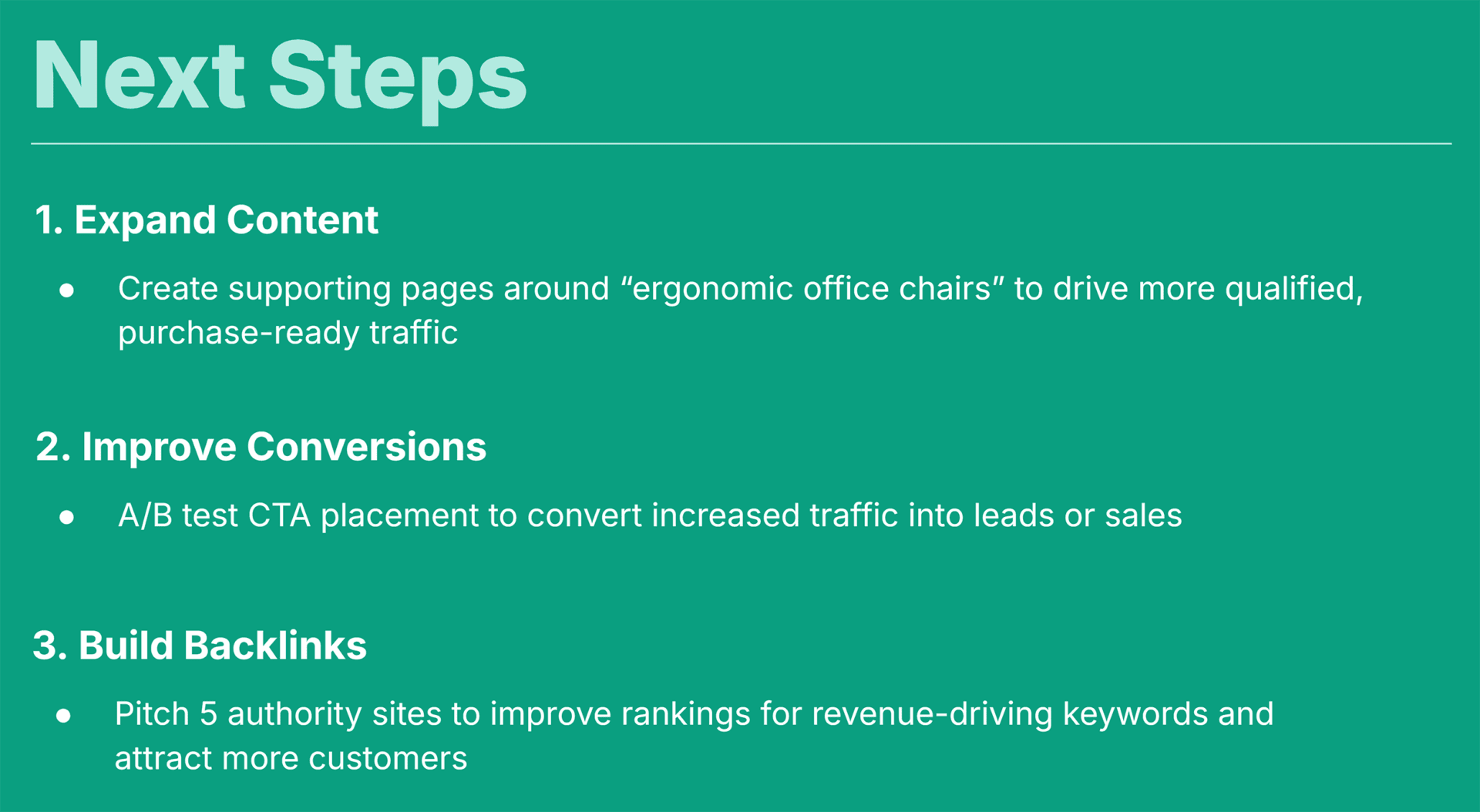
Next Steps
What needs to be tackled next?
Here’s your chance to include those thoughts for your stakeholders.
Include clear, actionable recommendations, like a fresh SEO audit or doubling down on high-performing content.
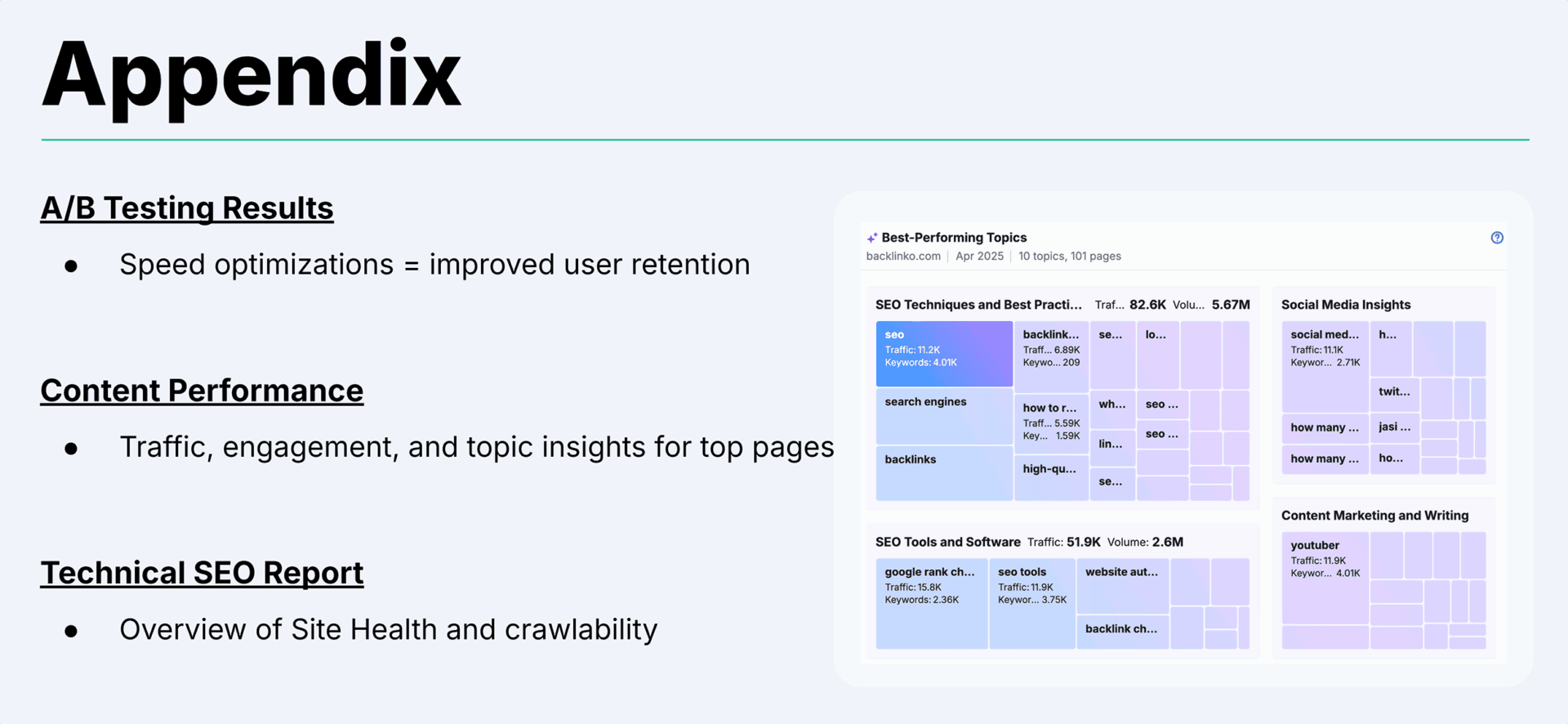
Appendix
This optional section includes deeper data for teams, stakeholders, and ongoing projects.
It helps keep the main report focused, while still delivering the context others may need.
Mistakes to Avoid in Your SEO Report
Even with the right data, your SEO report can still fall flat if it’s hard to interpret, misaligned with business goals, or missing a clear takeaway.
Here are some common mistakes to avoid — and how to fix them.
Reporting Data Without Context
Don’t just drop data into your report. Make it meaningful.
Show how it relates to business goals and your site’s overall SEO performance.
For every metric, briefly explain what it means, why it matters, and what action it might prompt your team or your client to take.

Surfacing Issues Without Providing Solutions
Reporting on every issue isn’t helpful unless it impacts your site’s SEO performance.
For example, say you note that a group of pages are experiencing index issues.
Include a hypothesis on why this is happening and how you might recommend fixing it.

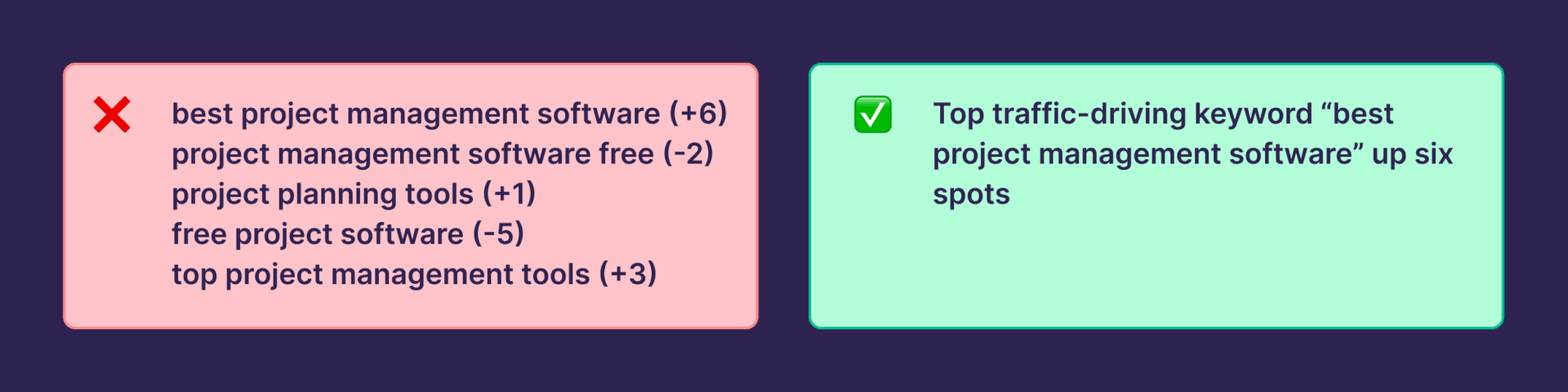
Listing Every Keyword Ranking
A full list of keyword shifts (especially minor ones) can bury your most important wins.
Instead, spotlight high-impact keywords — non-branded terms driving traffic or tied to revenue pages.
Including Every. Single. Page.
Reporting on every page creates noise, not insight.
Focus on the top 10 pages for organic traffic, or spotlight the top page in each key topic cluster.

Ignoring Business Outcomes
Your report might show SEO progress. But, does it show business progress?
Tie your work to signups, revenue, pipeline, brand visibility — whatever matters to your decision-makers.

Telling, Not Showing
You shared the data. But did you explain the story?
Use visuals, comparisons (e.g., MoM or QoQ), and commentary to walk the reader through what changed, why, and what’s next.

Show the Impact. Earn the Buy-In.
SEO reporting isn’t just about checking a box.
It’s your opportunity to show impact, earn trust, and steer strategy.
Surface insights that get stakeholders aligned and excited about what’s possible.
Source link
[ad_2]






0 Comments