

[ad_1]
This week’s question about author pages comes from Joylyn:
We are working on building author pages for our content, would you mind teaching us best practices for building author archive pages with any SEO best practices.
A great question and perfect for me to answer from a branding perspective.
Author pages serve to build trust, authority, and all of that good stuff. That much should be obvious.
However, a lot of nuance goes into leveraging author pages. More than that, I would challenge the very notion of what an author page is and why we need them.
What Should Be On Your Author Pages?
The answer to that depends on what you’re trying to accomplish.
Yes, you’re to establish trust, but how you do that depends on a variety of factors.
Say, for example, your industry is constantly evolving and changing. Harping on your author’s past may not be the way to go.
Instead, trust may be better built by focusing on their recent accolades and accomplishments. It can be as simple as showing they have written extensively on the topic recently.
In other words, you need to establish what “trust” means in your scenario because it’s not universal.
Think of your author pages as “About Pages.” There’s a certain narrative to a good About Page and you can do the same with your author pages.
Don’t just say who the person is, but show how they got there.
Trust is often about contextualization. Don’t think about only presenting who the author is – rather, try to paint a picture that frames them.
Author pages don’t just offer some background about your contributors but your site. They become a pillar of “who you are” across the web. Your authors aren’t just authors – they are representatives.
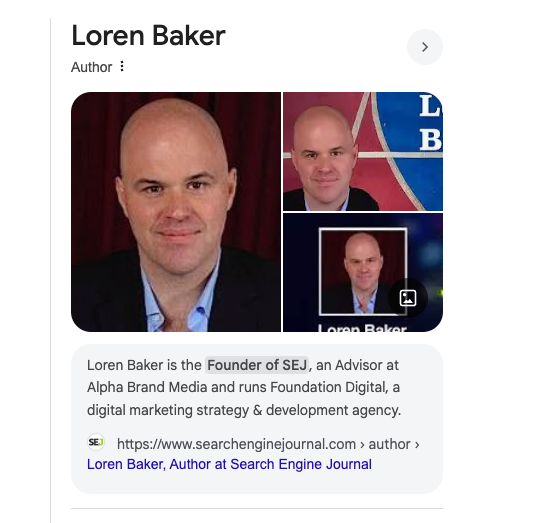 Screenshot from Google, March 2025
When someone runs across your author pages (perhaps by Googling one of your authors, as I did with Loren Baker above), they and the page connected with them substantiate who you are.
The authority of a good author page goes beyond visitors to your site.
If you’re running a marketing strategy that is heavy in employee advocacy, these pages are a major part of any outreach program.
If your goal is to get your own people out there repp’ing the brand on podcasts, webinars, conference stages, etc., the author page becomes a pillar. It becomes the “home” that represents your advocates and you at the same time.
This again speaks to the author page not merely being a list of credentials and accomplishments but as a narrative around the authors themselves.
If you’re trying to build your brand and performance by leveraging your employees, contributors, etc., you need pages that offer strong contextualization.
Even if you don’t use the bio/author page as part of the outreach per se, there’s a very good chance anyone interested will run some kind of search and find these pages on their own (again, as I did above).
Which brings us to…
Who Needs Author Pages?
Let me challenge the entire question. Why are we stopping at authors? The question should be, “Who needs people pages?” The answer is everyone whose company has any people. So, the answer is everyone.
Every business needs to contextualize itself via the people associated with it. That can be the CEO, CMO, CFO, CTO, or COO – I’m out of “Cs,” but it should not stop there.
When I see a company only list its top employees, it comes off as one giant ego stroke. So, mission accomplished: You have contextualized your business. I now know you’re a bunch of narcissists.
Even if you’re a solopreneur, there should be content that in a sense parses out who you are on the site.
I think we’ve come to look at “author pages” as being this very narrowed page type. To me, it’s the wrong way to look at them. It’s not an “SEO” play.
And when you think beyond SEO per se, is there really a difference between an author page and an employee bio page?
Yet, it’s funny because we’ll spend all day talking about how to bolster your author pages and then create one never-ending page for the employees that merely lists their names.
How exactly is that helpful beyond giving your user the ability to manually look up some of these folks on LinkedIn (which means leaving your website)?
So, who needs “author pages”? Everyone. The question is, what type of “author page” do you need? Can you combine your About Page and “author page”?
I do that on my own website since I’m a one-person show, and the format allows me that opportunity. I felt that having a separate page was a bit of overkill.
There’s a bio about who I am on my homepage and then a longer section on the About Page – do I really need to create another separate page to talk about me again? Doing so felt like it would be too much focus on myself and not my audience.
Again, it’s not a question of “if” you need some sort of author or bio page, but what kind and in what format?
Author Page Best Practices
That said, here are some quick best practices I would consider adding to your author pages (and similar “bio” pages). Some of them are obvious, like:
- Social links.
- Standard bio.
- Image.
- Recent posts.
- Formal industry recogniton (such as Search Engine Journal does with its “Certification & Awards” tab).
- Areas of expertise.
Some less so (and again, it all depends on your goals):
- Conference talks.
- Podcast, webinar appearances, and other “third-party placements” (similar to Search Engine Journal’s “Published Works” tab).
- Outlets where the author is quoted.
- Work experience (current and previous).
- History of how the author got into the industry and why.
- Personal industry philosophy (can even be a video).
The last thing I’ll say is: Watch the formatting.
99% of author pages, assuming they are substantial, feel like you’re reading a long article.
If you want to get the most out of the author page, you need to lay things out so that the audience can get a holistic sense of things at a glance.
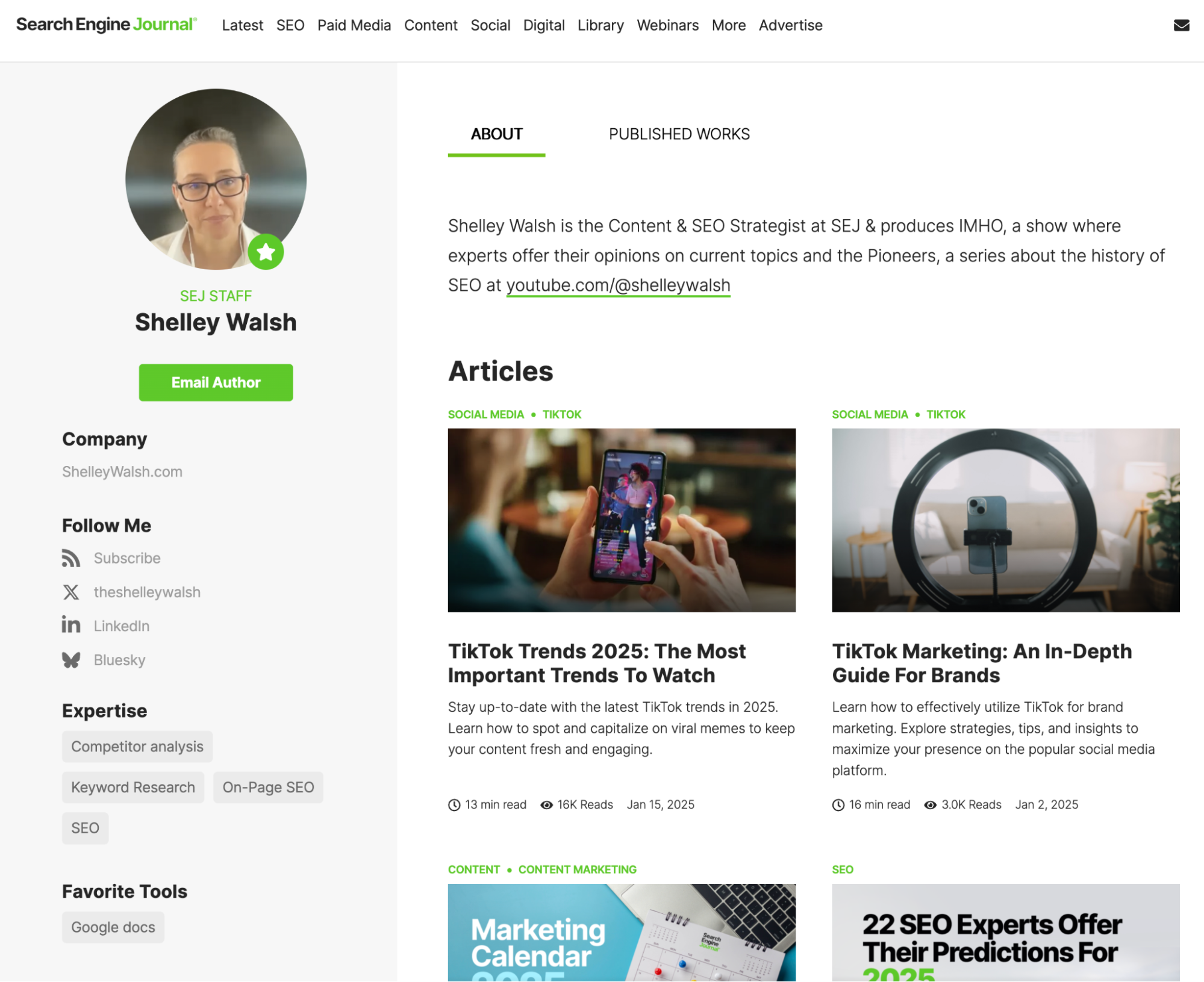 Screenshot from Search Engine Journal, March 2025
The Search Engine Journal layout is one of the best I’ve seen online (and I’m not saying that because I’m writing this on Search Engine Journal).
I don’t feel overwhelmed by information. It’s all “chunked” in a way where I clearly notice the various areas of information without having to work hard to see it all.
That’s why it works.
More Resources:
Featured Image: Paulo Bobita/Search Engine Journal
Source link
[ad_2]






0 Comments